August 2026
New Possibilities: Revisiting Bushwick Pride
As photographers, sometimes the photographs we make bear evidence of desires we haven't yet learned to recognize as our own. We return to the same subjects and themes, without always knowing why. Only in looking back at the work is its full meaning revealed to us. With this in mind, I decided to revisit past images, while contemplating new projects.
In July 2017, I traveled to NYC to visit friends and shoot street photography. While there, I documented the Bushwick Pride celebration in Brooklyn. This particular Pride celebration was unlike any I had seen before. Small, local non-profit organizations served as sponsors, rather than the large corporations often associated with Pride events in major cities. Bushwick Pride was primarily a neighborhood block party. It wasn't a high priced ticketed event with the largely white crowds I was used to seeing at Pride celebrations in L.A.
In the working class Brooklyn neighborhood where gentrification had increasingly become a threat, families sat on stoops and lawn chairs, watching the festivities, sipping cold drinks, and chatting with neighbors. Children roamed the street on bikes or waded in inflatable pools set up on the hot pavement, seemingly unfazed by the trans and queer performers pole dancing and breakdancing around them. Here, queer joy and queer life seemed ordinary and embedded in the everyday lives of residents in the neighborhood. The familial feeling of community and belonging among neighbors struck me as uniquely NYC.
In July 2017, I traveled to NYC to visit friends and shoot street photography. While there, I documented the Bushwick Pride celebration in Brooklyn. This particular Pride celebration was unlike any I had seen before. Small, local non-profit organizations served as sponsors, rather than the large corporations often associated with Pride events in major cities. Bushwick Pride was primarily a neighborhood block party. It wasn't a high priced ticketed event with the largely white crowds I was used to seeing at Pride celebrations in L.A.
In the working class Brooklyn neighborhood where gentrification had increasingly become a threat, families sat on stoops and lawn chairs, watching the festivities, sipping cold drinks, and chatting with neighbors. Children roamed the street on bikes or waded in inflatable pools set up on the hot pavement, seemingly unfazed by the trans and queer performers pole dancing and breakdancing around them. Here, queer joy and queer life seemed ordinary and embedded in the everyday lives of residents in the neighborhood. The familial feeling of community and belonging among neighbors struck me as uniquely NYC.
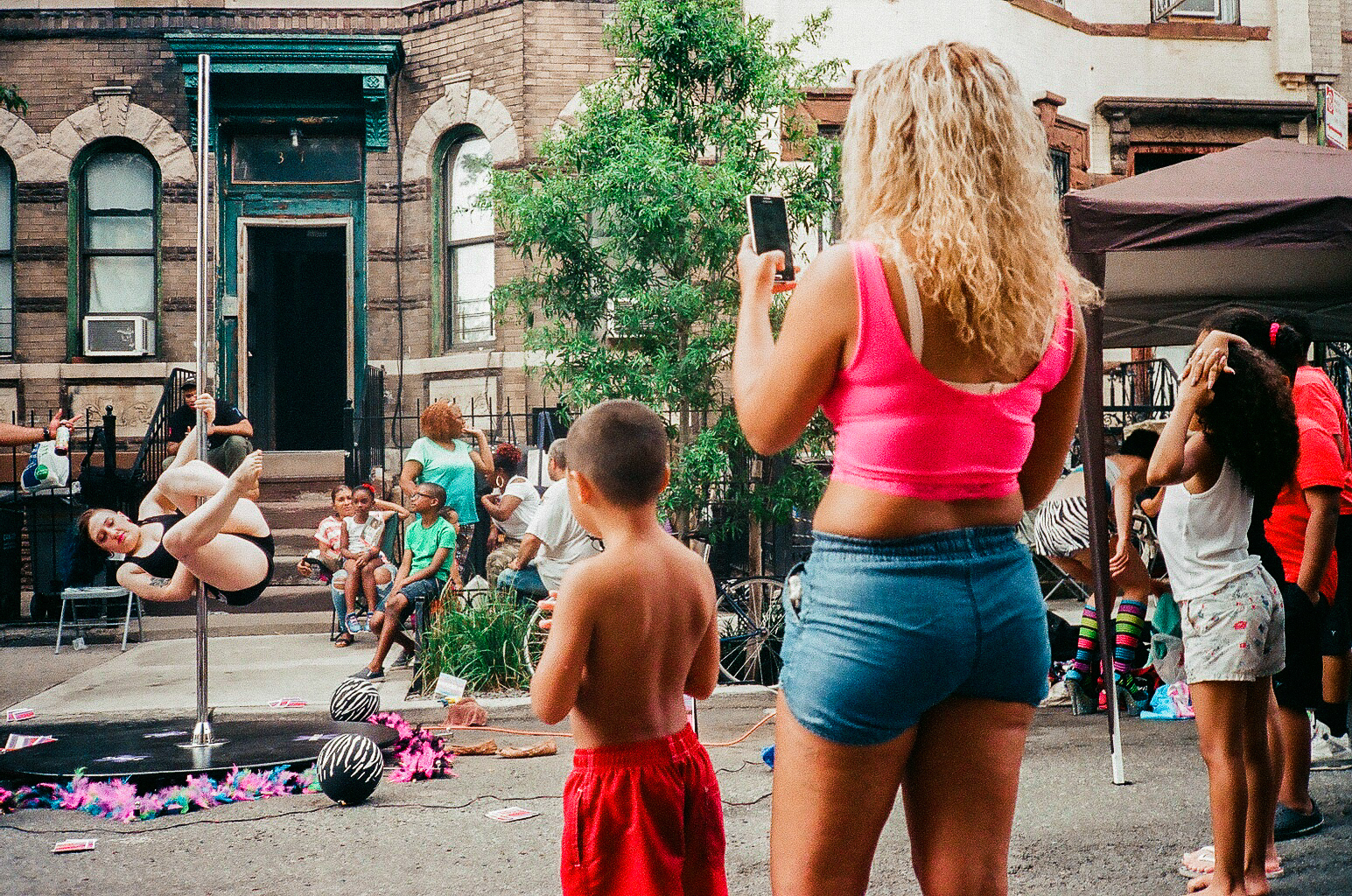
While taking photos, I found myself visually drawn to the children who were spectators to the celebration. I placed them at the center of several of my photographs, documenting them as witnesses, even as I witnessed them in return. I noticed that unlike most of the adults around them, they were not holding up phones to record the performances. They were fully present and simply taking it all in. At the time, I thought of the children's presence mainly as a visual device for photographic framing. Revisiting the work, I can now see that I was capturing something far more personal and significant.
Earlier this year, with the help of a trusted therapist, I began opening up about childhood traumas I had spent decades keeping under wraps. Our discussions gave me new ways of understanding my childhood, my family, my early environment, and other things that previously felt too heavy to hold alone.
Despite familial roots that began in NYC, I spent my childhood living in Orange County, California. My years growing up in Anaheim, in the shadow of the so-called Happiest Place on Earth, were anything but happy. Although geographically Orange County is just thirty miles south of Los Angeles, it was - and remains - a place where Republican politics, conservative values, fundamentalist religion, racism, classism, and homophobia were staples of life. As a child in the 1980s and 1990s, the scenes I would later photograph at Pride in Bushwick would have been unimaginable to me.
Earlier this year, with the help of a trusted therapist, I began opening up about childhood traumas I had spent decades keeping under wraps. Our discussions gave me new ways of understanding my childhood, my family, my early environment, and other things that previously felt too heavy to hold alone.
Despite familial roots that began in NYC, I spent my childhood living in Orange County, California. My years growing up in Anaheim, in the shadow of the so-called Happiest Place on Earth, were anything but happy. Although geographically Orange County is just thirty miles south of Los Angeles, it was - and remains - a place where Republican politics, conservative values, fundamentalist religion, racism, classism, and homophobia were staples of life. As a child in the 1980s and 1990s, the scenes I would later photograph at Pride in Bushwick would have been unimaginable to me.
In the Ronald Reagan-loving suburban wasteland I grew up in, the idea of LGBTQ Pride itself would have seemed like an inconceivable fever dream to my childhood self. I had no frame of reference for queer or trans people loving themselves, being out, or simply occupying public space. Most queer people learned to survive in Orange County by being closeted. My own family had a very strict, Don't Ask, Don't Tell policy that meant any open discussion of being queer would be shut down, shamed, or invalidated.
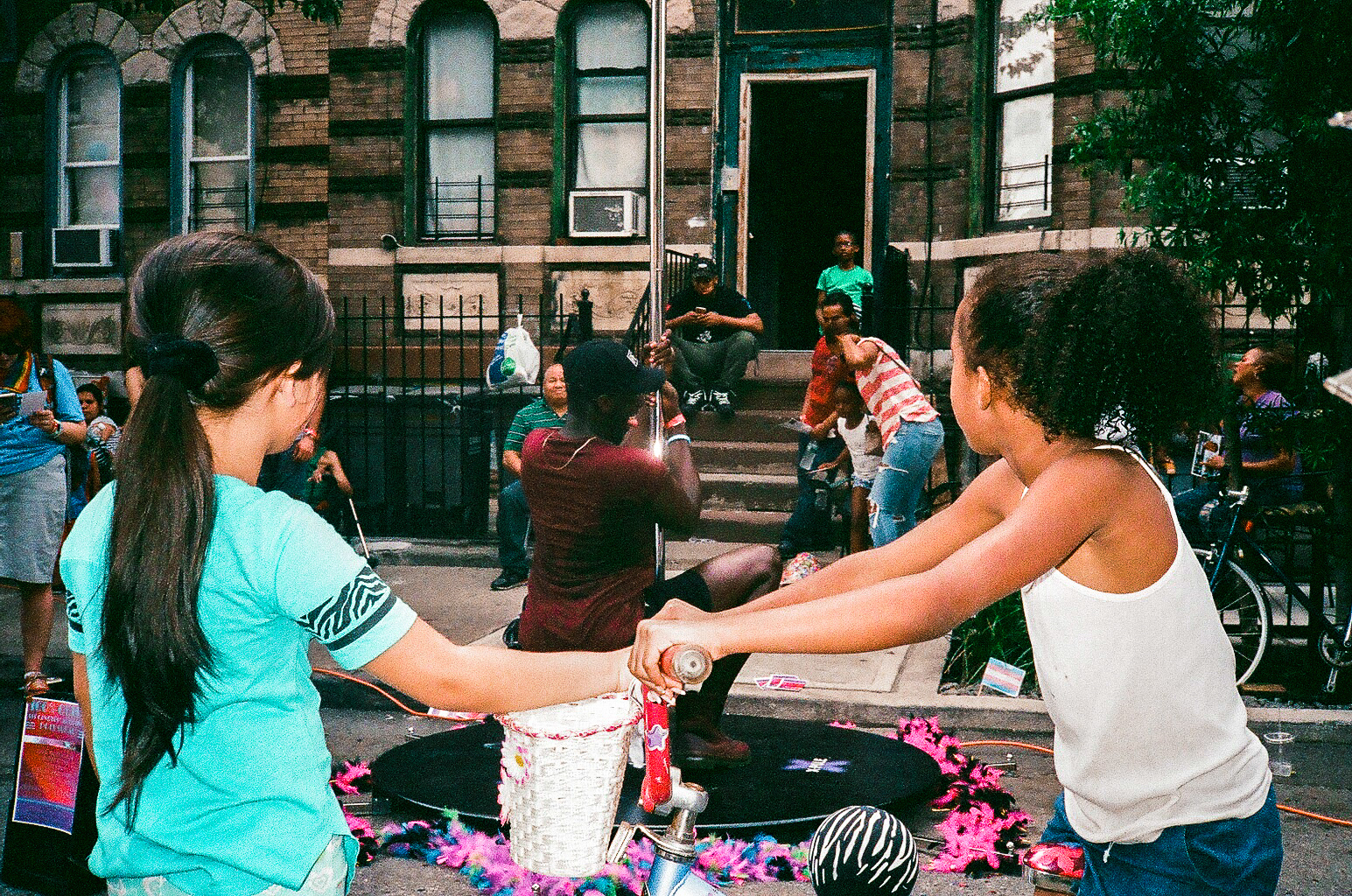
Returning to the photos, I now see that what I captured was a kind of reimagining of my own childhood. Not the one I actually had. But the one I wished I had experienced where children grow up being aware of queer people's existence, their joy, their creativity, and yes, their pride in being unapologetically themselves. Shot on expired, grainy film, and with the exception of the visible cellphones, these images look like they could have been made in the 1980s or 1990s, rather than in 2017, just six months into Trump's first term as president. I see my nine year old self in the image of the ponytailed girl riding a bicycle with a basket at the front. I see her looking on, curious, taking in joy instead of shame.
Returning to the photos, I now see that what I captured was a kind of reimagining of my own childhood. Not the one I actually had. But the one I wished I had experienced where children grow up being aware of queer people's existence, their joy, their creativity, and yes, their pride in being unapologetically themselves. Shot on expired, grainy film, and with the exception of the visible cellphones, these images look like they could have been made in the 1980s or 1990s, rather than in 2017, just six months into Trump's first term as president. I see my nine year old self in the image of the ponytailed girl riding a bicycle with a basket at the front. I see her looking on, curious, taking in joy instead of shame.
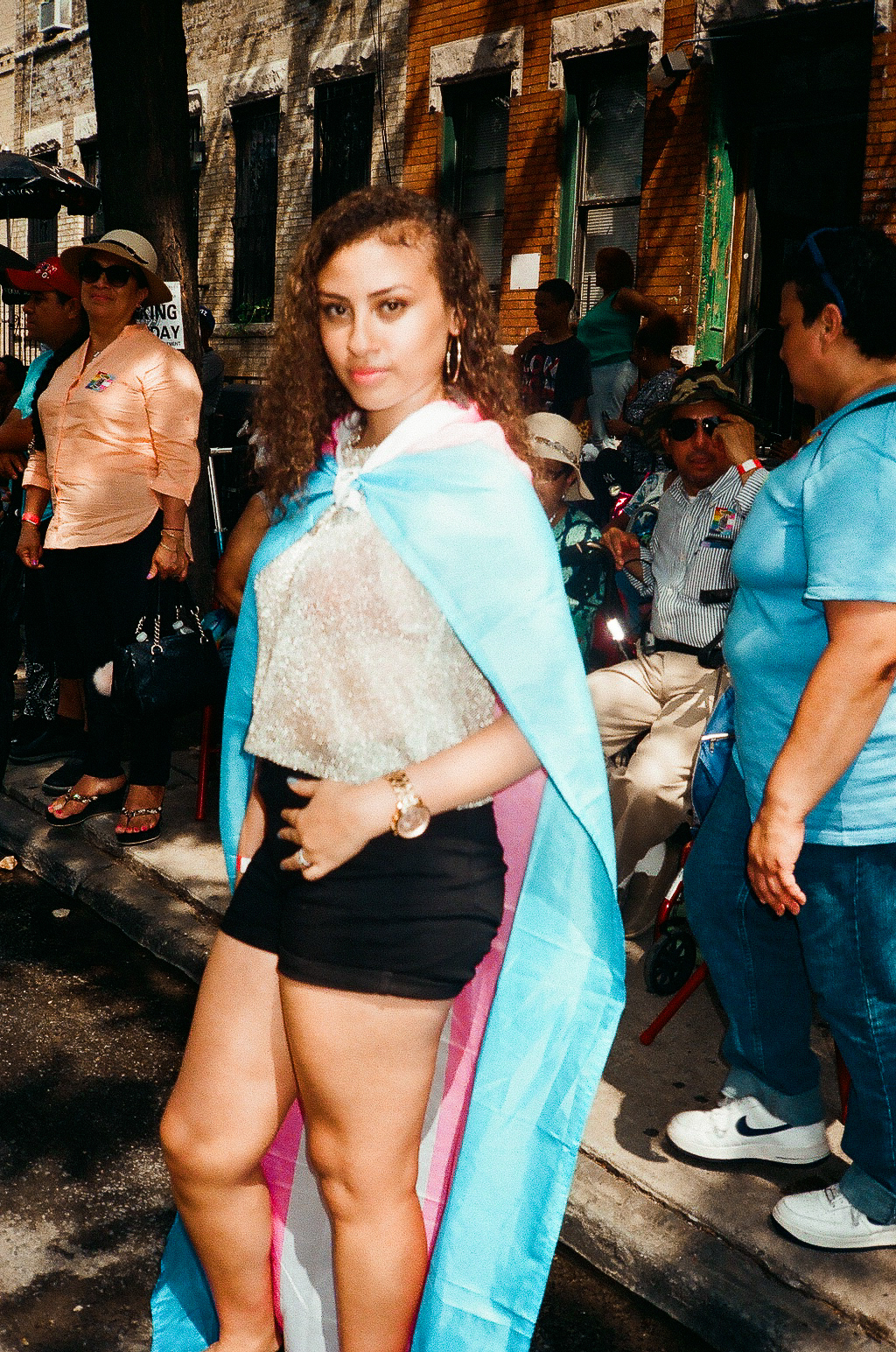
The beauty in having a photographic practice is that the work continually reveals the values, desires, and even fears I hold most deeply, sometimes even without my conscious knowledge while making the images. I consider every significant photo I have ever made to be a self portrait, whether I am in the frame or not. More than just surface-level documentation, these photos allowed me to see what I had been denied growing up and could now reclaim by witnessing with my camera. The photographs are not just records of what I saw; they are living proof of new possibilities for both the children I captured and the child I was.
|||||
August 2026
Bearing Witness: On Laura Aguilar
I have been unable to stop thinking about Laura Aguilar or her work since seeing it in person for the first time earlier this month. I took myself on a solo birthday date to The Huntington Library & Museum in San Marino to see her exhibit Laura Aguilar: Body and Landscape. I was familiar with Laura’s work. I had seen it online and in books many times. But nothing prepared me for my own reaction to seeing it face to face.
Laura Aguilar’s name was never supposed to appear in the canon of American photography. Born in 1959 in the San Gabriel Valley of Los Angeles, California to a Mexican-American father who was a welder and Mexican/Irish mother who cleaned homes, Laura was never expected to enter into the gate-kept halls of largely white institutions like The Whitney Museum, The Getty, or the Museum of Modern Art. She learned photography at East LA Community College, not by earning a BFA or MFA from a high-priced art school with a pedigree and pipeline to commercial success.
Growing up, Aguilar struggled to communicate verbally due to auditory dyslexia that made her mispronounce words and hear spoken words incorrectly. Painfully shy and in a larger body that was deemed “unacceptable”, she was often the target of bullying. Visual language became her way of making sense of her inner world. In the mid 1980s, she came out as lesbian, adding to her sense of marginalization.
It took her longer to embrace the "Chicana" identity that she had been taught to dismiss growing up. Like many native Californians with Mexican roots, she grew up speaking only English, and never felt fully accepted by her Latino peers because of this. The combination of so many different forms of invisibility and erasure led to depression and suicidal thoughts, which plagued her throughout her life. Through her art, she took the pain of erasure and made herself visible. First to herself, and then to viewers.
It took her longer to embrace the "Chicana" identity that she had been taught to dismiss growing up. Like many native Californians with Mexican roots, she grew up speaking only English, and never felt fully accepted by her Latino peers because of this. The combination of so many different forms of invisibility and erasure led to depression and suicidal thoughts, which plagued her throughout her life. Through her art, she took the pain of erasure and made herself visible. First to herself, and then to viewers.
It is her unflinching honesty and vulnerability that was most disarming for me to encounter face to face. Aguilar inserts her large, nude, brown body into desert landscapes, becoming one with the natural world she often sought refuge in. As if by ancestral instinct, she was returning to the land her Mexican and indigenous ancestors had lived on for five generations on her mother’s side, long before the land now called California became part of the United States. Her bloodline survived here, was buried here, took root here. Her body was not inserting itself into a foreign landscape. It belonged here.
Looking at her nude landscape self portraits, I felt overcome with emotion in a way I have never experienced viewing any other work before. The work made me question the nature of beauty itself and who and what that label does and does not get ascribed to, and why. The curves, lines and crevices of Aguilar's body held great beauty. Her body mirrored the red earth, the brown boulders, and jagged Joshua trees that seemed to welcome and embrace her. For the artist, the work offered a way to begin healing from society's contempt and mischaracterizations.
Every time the depression comes up, I can look at the artwork and say, "you feel content there, you feel comfortable there."
“I’m trying to convince myself I’m not what I always thought of myself: ‘I’m ugly, I’m fat, I’m not worth living. I am these things, too: I am a kind person, a funny person, a compassionate person. In the photographs I’m beautiful. I’m kind to myself.”
Laura Aguilar, artist statement (from the Grounded series / "Show and Tell" retrospective, 2017)
Laura Aguilar, artist statement (from the Grounded series / "Show and Tell" retrospective, 2017)
In her images, I saw and remembered my mother’s body. I saw and felt my mother’s private pain about that body and the grief and misplaced shame it caused her throughout her life. I saw the bodies of all the brown and black women who had ever been made to feel unlovable simply because their shapes took up “too much” space in a society that says only near skeletal white bodies are beautiful or desirable.
I saw and felt pain coming through those images in a way that felt as if Laura were in the room with me. But these were not “dark” or depressing images. Her photographs embodied self-love and self-acceptance. There was a sanctity to the work and to her intentions that began to overwhelm me with a profound feeling of grief. Embedded in that grief, I found immense gratitude. Her photographs invited me to shed my own shame about the various ways I have been made to disown my body throughout my life.
Alone in the small blue gallery room, surrounded by her self portraits, I sat down on the bench in the center of the room and could not help but cry. My private moment of grieving was quickly interrupted by a group of young white men entering the gallery. They were accompanied by an older white man who seemed to be some kind of authority figure to them. Perhaps a father, coach, or teacher. All of them seemed to be from someplace else. Without centering these men when talking about Laura’s work, I will just say that they began to make degrading comments about her body in the photos. The older male with them did not correct or admonish them. In fact, he joined in. Being unable to withstand hearing another minute of their disrespect, I stood up.
Broccoli-headed buffoons would not be degrading Laura or her work in my presence. When they remarked that her images in the Grounded series were “disgusting” and "gross", I quickly shot back loudly and with contempt that they were the truly disgusting ones. Without the online comment section that usually emboldens and accompanies body shaming of women or racist comments, they appeared powerless. Confronted in real life by a real person standing in front of them, turning the tables and shaming them publicly, they had no response. They turned to look at me, but quickly left with their heads down.
The exchange shook me further. Even years after her death, in an exhibition meant to celebrate her work, no less, Laura was still being degraded by people who viewed her as a body and not a person. To these men, she was merely a physical form and not an accomplished artist whose work and personhood held inherent value. Seeing what happened, the middle-aged Latina security guard, who had been standing by, quickly left her post and asked if she could hug me. We had spoken earlier about Laura's work and what it meant to each of us. In her embrace, I felt not just comfort but recognition. Together we knew what Laura's work meant, and who it was truly for.
The exchange shook me further. Even years after her death, in an exhibition meant to celebrate her work, no less, Laura was still being degraded by people who viewed her as a body and not a person. To these men, she was merely a physical form and not an accomplished artist whose work and personhood held inherent value. Seeing what happened, the middle-aged Latina security guard, who had been standing by, quickly left her post and asked if she could hug me. We had spoken earlier about Laura's work and what it meant to each of us. In her embrace, I felt not just comfort but recognition. Together we knew what Laura's work meant, and who it was truly for.
Her work was never for those basic white boys or people who thought like them. Her work was for the people who had never seen themselves as beautiful or worthy and didn’t think their image or their work belonged on the walls of galleries. She showed us we belonged in the world and could take up space within it. She showed us it was not necessary to ask permission to do so. Laura’s work provided a framework proving we could be artists too and our work could matter. With her untimely death in 2018 at just 58 years old, she left behind a photographic and personal legacy that will not be erased.
Laura in her own words
UCLA Chicano Studies Research Center hosts a huge repository of documents and knowledge about Laura’s work. They are in invaluable resource for learning more about her.
Laura in her own words
UCLA Chicano Studies Research Center hosts a huge repository of documents and knowledge about Laura’s work. They are in invaluable resource for learning more about her.
|||||
Black Out Poem
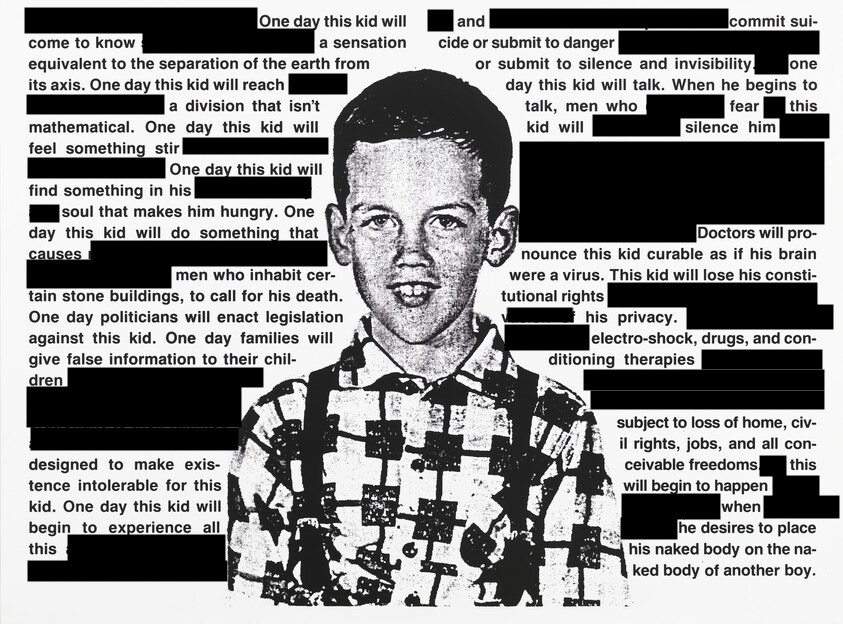
Source Text: David Wojnarowicz | Untitled (One Day This Kid...) 1990
One day this kid will come to know
a sensation equivalent to the separation
of the earth from its axis.
One day this kid will reach a division
that isn't mathematical.
One day this kid will feel something stir.
One day this kid will find something in his soul
that makes him hungry.
One day this kid will do something that causes
men who inhabit certain stone buildings,
to call for his death.
One day politicians will enact legislation
against this kid.
One day families will give false information to their children,
designed to make existence intolerable for this kid.
One day this kid will begin to experience all this,
and commit suicide or submit to danger,
or submit to silence and invisibility.
One day this kid will talk.
When he begins to talk,
men who fear this kid,
will silence him.
Doctors will pronounce this kid curable,
as if his brain were a virus.
This kid will lose his constitutional rights,
his privacy.
Electro-shock, drugs, and conditioning therapies.
Subject to loss of home, civil rights, jobs,
and all conceivable freedoms.
This will begin to happen when
he desires to place his naked body,
on the naked body of another boy.
April 2026